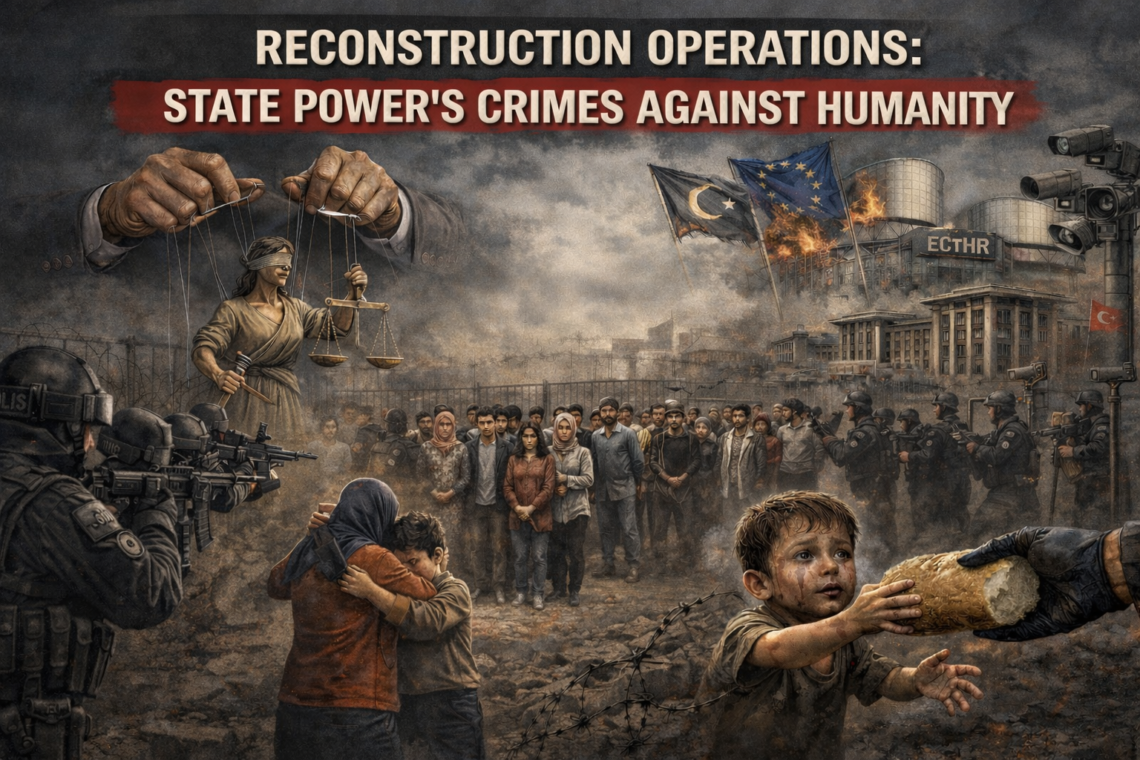
The operations carried out in Turkey since July 15, 2016, under the guise of combating the Gülen movement, continue uninterrupted in 2026 under the label of “restructuring.” These operations have far exceeded the bounds of a counter-terrorism matter; they have become the primary instrument of legitimacy and control for the existing political order. Described in legal literature as the “instrumentalization of criminal law,” this process has simultaneously become a tool that systematically erodes social solidarity, humanitarian compassion, and the most fundamental moral values.
1. Why Don’t the Operations End? Political Survival and the “Bicycle Theory”
The government’s refusal to end these operations is not a security necessity but a political survival strategy. This can be likened to the balance of a bicycle: to keep the bicycle from falling, the pedals must keep turning — meaning the system must continuously produce new threats and enemies to maintain its legitimacy. The moment the operations end, public attention will shift to economic crises, inflation, meritocracy failures, and the search for justice. The “restructuring” thesis keeps the pedals turning by claiming the enemy has not died, only changed form.
This has become the primary “fuel” of politics. As journalist Rasim Ozan Kütahyalı has frequently emphasized, the observation that “Every time Kemalists say FETÖ, they are actually serving Tayyip Erdoğan” captures the issue in a strikingly accurate way. The ruling bloc’s greatest achievement on the side of evil in this process has been normalizing this collective wrongdoing by making all layers of society into “involuntary accomplices” in the demonization of the Gülen Movement. Through this mass complicity, the oppression has been lifted out of the hands of a narrow circle and embedded into an entrenched system of elimination — one that is extremely difficult to remedy or reverse, bound together by a “partnership in evil” that has permeated the entire society.
Each new operation is logged as a victory for the ruling power, passivizing opponents and mobilizing its base. Indeed, thousands of operations were conducted against the movement in 2025, with 1,395 suspects detained in a single period alone. Operations have continued routinely into the early months of 2026. At the time of writing, news has emerged of operations against “FETÖ” across 26 provinces, with 90 individuals taken into custody.
2. “Disciplining Society,” the Climate of Fear, and the Obstruction of Solidarity in Light of Surah Al-Ma’un
The most tangible sociological outcome of the restructuring operations is the construction of a pervasive self-censorship reflex and a systematic mechanism of mental conditioning that has spread throughout society. The re-detention of individuals who have already served their sentences and been released undermines the principle of legal security and sends a clear message: “You will never be considered fully exonerated.” This fear does not only passivize those directly targeted, but also neutralizes all opposition through the constant anxiety of “being swept up in a dragnet investigation at any moment.”
The most tragic illustration of this mental conditioning mechanism is the judicial harassment suffered by the Sözcü newspaper and its columnists — once considered a stronghold of the opposition — leading to their effective absorption into pro-government media. The retreat of these voices, driven by fear of imprisonment or asset seizure, sends society the message that “even the strongest voices have been silenced.” This is not merely a media realignment; it is the consolidation of reality perception under the ruling power’s monopoly and the rendering inoperative of independent oversight mechanisms.
This is also where the deepest dimension of the issue comes into view: the restructuring operations are, in essence, an operation to systematically obstruct simple humanitarian aid — those small, everyday kindnesses that the Quran’s Surah Al-Ma’un describes as “yamna’ūna al-māʿūn.” Surah Al-Ma’un strongly condemns those who deny religion, repel the orphan, fail to encourage the feeding of the poor, perform prayer merely for show, and refuse “even the smallest act of neighborly assistance.” The word māʿūn refers to a pot, a piece of cookware, a handful of flour, a morsel of bread given to a neighbor, a small act of help extended to someone in need. The Surah regards the obstruction of precisely these small but sincere acts of solidarity as the most fundamental test of faith and morality. To criminalize these small acts of help is therefore not merely a legal violation — it is a deliberate effort to sever society’s moral foundations and cause the most basic test of faith and humanity to be failed.
Every operation conducted today under the name of “restructuring” obstructs precisely this māʿūn. Sending a food parcel to the family of a released detainee, sending a holiday greeting to a former acquaintance, or lending a hand to a neighbor in need is treated as evidence that “organizational ties remain intact,” driving people apart. This is a known and oft-repeated truth — a moral principle that has stood for millennia: when solidarity is suppressed, society decays. The ruling bloc, having made this suppression its primary function, will never relinquish it — for obstructing māʿūn feeds fear and dependence. It is indispensable for disciplining society, setting people against one another, and keeping alive the perception that “you cannot survive without us.”
This also deliberately erodes the universal legal principles of specificity (typicality) and the requirement of a material element. The classification of acts of humanitarian aid under an “organizational hierarchy” proves that criminal law is being instrumentalized as a tool for “social disciplining and intimidation.” This strategy of obstruction, elevated to a state policy by the ruling bloc, aims to condemn the masses to absolute dependency by stripping them of their assets and isolating them.
3. Legal Parameters and Court of Cassation Precedents: The Legal Nature of Humanitarian Aid
Criminal law doctrine and the jurisprudence of higher courts establish unequivocally that acts carried out with humanitarian intent cannot constitute a crime. As emphasized in the scholarly works of Prof. Dr. Ersan Şen and Attorney Mehmet Vedat Ervan, for the crime of aiding an organization to be established, it is not sufficient for the act to have merely taken place in the external world — it is essential that the “special intent” in the perpetrator’s mind be proven beyond any reasonable doubt. In this context, the established decisions of the Court of Cassation shed light on the matter:
- Court of Cassation 16th Criminal Chamber, 05.07.2019, E. 2019/521, K. 2019/4769: “For the mental element of the crime of aiding an organization to be established, general intent is insufficient. It is a crime committed with special intent.”
- Court of Cassation 16th Criminal Chamber, 30.09.2020, E. 2020/1029, K. 2020/4660: The aid must be of a nature that serves the organization’s objectives and must be rendered with special intent.
- Court of Cassation 16th Criminal Chamber, 06.10.2020, E. 2019/11549, K. 2020/4726 and Court of Cassation 3rd Criminal Chamber, 22.11.2021, E. 2021/8301, K. 2021/10127: In FETÖ/PDY files, a Bank Asya account and past associations are insufficient on their own; where the perpetrator has distanced themselves from the organization, acquittal is required due to the absence of special intent.
Despite these binding decisions of the high court, a grave deviation in practice is observed in current “restructuring” cases. Holiday greetings, social media interactions, and the most basic humanitarian assistance — which legally constitute no crime — are being treated as criminal evidence through a contrived “chain of inference,” in direct violation of the Court of Cassation’s criterion of “concrete evidence leaving no room for doubt.”
This renders inoperative the foundational principles of criminal law: the principle of legality in offenses and punishments (Constitution, Art. 38) and the principle of typicality (Turkish Penal Code, Art. 1).
Ultimately, such a pronounced rupture between judicial practice and established jurisprudence is not a difference in legal interpretation — it is an open admission that the judiciary is acting entirely on political motivations and that the executive has transformed into a punishment apparatus. The disregard of the Court of Cassation’s binding decisions by lower courts shows that judicial independence has been replaced by a reflex of “compliance with political directives.” This eliminates legal security and sends society the message that the judiciary is no longer a forum for justice, but a “bludgeon” wielded to preserve the ruling power’s survival. The will imposed on individuals — “you will never be exonerated” — is thus a testament to an era of interregnum in which the rule of law has been supplanted by executive domination.
4. The Denial of ECtHR Rulings: The Suspension of the Rule of Law Through the “Restructuring” Fiction
The European Court of Human Rights (ECtHR) issued a record number of violation rulings against Turkey in 2025 in thousands of cases filed under the label “FETÖ/PDY.” Following the Yüksel Yalçınkaya judgment (2023 Grand Chamber), the number of violations surpassed the thousands through collective rulings such as Demirhan and Others (July 22, 2025, 239 applications), Bozyokuş and Others, Karslı and Others, and Seyhan and Others (December 16, 2025, totaling 2,420 applications). The Court has explicitly confirmed that detention, conviction, and re-investigation processes carried out without concrete, individualized evidence capable of creating “reasonable suspicion” — including the use of ByLock — violate Articles 5, 6, and 7 of the European Convention on Human Rights. The ECtHR characterized the Turkish judiciary’s “categorical approach” — treating past affiliation or lawful acts as automatically constituting organizational activity — as a systemic problem, and identified retrial as the most appropriate remedy.
Yet with these rulings in place, the “restructuring” operations continue unabated. Humanitarian acts such as sending food packages to the families of released individuals, exchanging holiday greetings, or engaging on social media are being made the subject of new investigations on the grounds that “cell structures remain” or that “ties have not been severed” — with the ECtHR’s standards of “individualization” and “concrete evidence” entirely disregarded. Although the retrial mechanism under domestic law (Code of Criminal Procedure, Art. 311) remains theoretically available, it is rendered ineffective in practice, as the same facts are repackaged as new cases under the “restructuring” heading.
This picture clearly demonstrates that the law is being instrumentalized against the political will. The ECtHR has repeatedly emphasized that “reasonable suspicion” cannot be substituted with an abstract “threat perception,” and that humanitarian aid cannot be treated as a crime unless it contains elements of propaganda. The continuation of operations despite this constitutes the most concrete proof of the bicycle theory: legal obligations do not permit the pedals to stop — on the contrary, new “covert structuring” theses cause them to turn even faster. The result is the erosion of legal security not only for the victims, but for society as a whole. The ECtHR’s collective rulings in 2025 called on Turkey to “resolve the systemic problem”; yet the ruling power’s objective and strategy of eliminating the Gülen movement deliberately ignores universal legal norms and these calls alike.
The ECtHR’s 2025 collective rulings called on Turkey to “immediately end systematic human rights violations.” Yet this understanding — which places political objectives above the rule of law — elevates the practice of obstructing humanitarian solidarity above every human value, and reduces justice to a mere instrument of political interest.
5. The Perception That “The Threat Is Still Ongoing” and a Multi-Purpose Strategy
The perception that “the Gülen movement is restructuring and the greatest threat is still not over” is deliberately kept alive in the minds of a large portion of the public. This perception is an extremely functional tool in the ruling power’s hands, operating like a strategy of killing multiple birds with one stone:
Replacing Political Survival with “Fear”: Continuously refreshed “danger” messages generate loyalty among voters not through consent but through “fear of chaos.” Any legitimate opposition can thereby be easily criminalized as “harmful to counter-terrorism efforts” and neutralized.
Expanding the scope for plunder and resource transfer: The extraordinary measures taken under the guise of “national security” and “counter-terrorism” create a broad legitimacy shield for trustee appointments, TMSF operations, and the redirection of public resources. This makes it easier to plunder national resources and channel wealth into specific hands.
Silencing and passivizing the opposition: Every critical voice is met with the suspicion, “Are you helping (so-called) FETÖ?” This enables anyone who appears oppositional to be easily classified as an “internal enemy.”
Making an impoverished society dependent on the state: By systematically obstructing small acts of solidarity between people, individuals are isolated from one another. As solidarity dies, impoverished segments of society become increasingly dependent on the state and the ruling power. This dependency gradually converts into electoral potential. The message “there is no one but us to give you bread” is one of the most effective methods of harvesting votes through fear and dependency.
Considered together, “restructuring” operations transcend a simple security matter and transform into a multi-layered political, economic, and sociological strategy of power. Keeping the threat perception alive, feeding fear, killing solidarity, and controlling resources — all are parts of the same mechanism.
6. The International Dimension: The Rome Statute and Crimes Against Humanity
The Rome Statute of the International Criminal Court (1998), in defining “crimes against humanity” under Article 7, clearly sets out the key elements that distinguish them from individual crimes. In this context, the processes carried out under the name of “restructuring” must be evaluated in light of the following international criteria:
Systematic and Widespread Attack (Article 7/1): According to the Statute, for this crime to be established, the acts must not be isolated judicial cases but must form part of a widespread or systematic attack against a civilian population, as an extension of a state policy.
Article 7(2)(a): An “attack directed against any civilian population” means a course of conduct involving the multiple commission of acts referred to in paragraph 1 against any civilian population, pursuant to or in furtherance of a State or organizational policy to commit such attack.
Group-Based Persecution (Article 7/1-h): The systematic deprivation of fundamental rights and subjection to systematic oppression of a specific religious, political, or otherwise identifiable group on the basis of its identity is defined as the crime of “persecution.”
The “restructuring” operations are precisely the embodiment of this legal definition. The ruling power mobilizes the entire state apparatus — law enforcement, the judiciary, and intelligence services — to target a civilian group encompassing millions of people. The endless post-release investigations and the criminalization of humanitarian solidarity are manifestations of a state policy aimed at isolating this group from society and condemning them to “civil death.”
Although Turkey has not formally ratified the Rome Statute, the acts in question violate the highest norms of international law — jus cogens (peremptory norms). Jus cogens represents universal red lines that states cannot alter even by mutual agreement and are bound to observe regardless of whether they have signed on. The prohibition of crimes against humanity stands at the forefront of these absolute rules.
History bears witness: such systematic persecutions targeting the destruction and isolation of a civilian population — however powerful their perpetrators may appear today — will not be able to transcend the shield of jus cogens and will, sooner or later, face accountability before international criminal justice or the unerring conscience of history.
Conclusion: The Dominance of Those Who Block Humanitarian Aid and the Inertia of the Opposition
Since 2016, the “restructuring” operations have ceased to be a simple law enforcement matter and have become the primary engine of the existing executive practice. The moment this engine stops, the artificially constructed legitimacy upon which the system rests will also collapse. For the fabricated perception of “threat” is an energy source that expands the ruling power’s room for maneuver in domestic politics, serves as a bargaining chip in foreign policy, and ensures societal control. The ultimate objective of this strategy is to weaken the bonds of social contract between individuals — and to confine the masses in a spiral of absolute dependency — by eliminating the networks of social solidarity, precisely through the obstruction of that “small act of help” so forcefully condemned in Surah Al-Ma’un.
Where, then, does the opposition stand in the face of these systematic legal violations? Unfortunately, the current opposition bloc’s will to defend rights, law, and universal principles of justice does not extend beyond pragmatic political calculations. Their priority is not to establish the rule of law without discrimination, but to take over the management of public resources. The legal and humanitarian predicament of the impoverished, the orphan, the destitute, and obstructed humanitarian aid remains a secondary matter on their political agenda. They too are part of the same status quo, and they are merely pursuing a transfer of authority.
Yet this passive stance is not merely a moral failure — it is also political suicide. For the machinery of lawlessness that is being operated against others today has become a monstrous force that will, tomorrow, devour them as well. By remaining silent in the face of this oppression — boxed in under the labels of “terrorism” and “security” — the opposition is in fact narrowing its own political space and turning the ruling power’s “bludgeon” into its own executioner. It must not be forgotten: those who do not defend universal legal principles for everyone will be the first to be deprived of the protection those principles afford. This spiral of lawlessness has already struck — and will continue to strike — an opposition that refuses to see the present.
In conclusion: as long as this judicial cycle remains unbroken, neither legal security nor social peace will be possible. The way out of this dark process begins only with the abandonment of the practice of obstructing māʿūn and the condemnation, within the framework of legal norms, of this systematic oppression committed against humanity.1
Mahmut Haldungil, Attorney at Law
- For the original article, see: https://amsterdamlawcenter.com/tr/genel-tr/yeniden-yapilanma-operasyonlari-devlet-gucuyle-islenen-insanliga-karsi-suc/ ↩︎