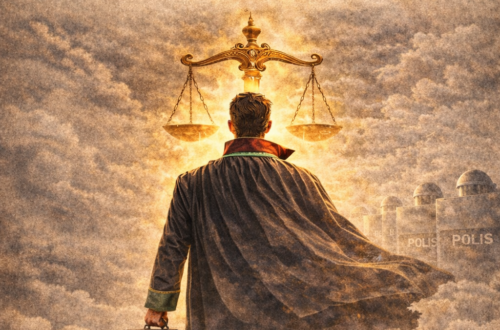

Throughout history, it has been the only fortress standing upright against those in power, amplifying the individual’s voice and giving concrete form to justice. In ancient times, justice was often weighed on the scale of brute force: the strong were deemed right, and the weak were forced into silence.
The true beginning of civilization emerged precisely at this moment: when written laws, the principle of equality, and an independent defense mechanism rose against raw power, humanity stepped out of a dark cave and into the light.
The lawyer is the guardian of that light.
A steadfast shield balancing the limitless will of the powerful with the unshakeable scales of law; suppressing the tyranny of arbitrariness with the dignified word of justice; pulling human dignity out of the shadow of oppression. From the agoras of Ancient Greece to the Roman forums, from medieval courts to modern courthouses, the lawyer has always been the people’s conscience, their final voice, and their strongest shield against unchecked authority.
To be a lawyer is to be the defense.
And the defense is the people: the voice of the oppressed, the silenced, the victimized, the abandoned. This profession is the lifeblood of democracy; because true democracy can exist only where everyone is defended equally, fearlessly, and effectively. A lawyer’s robe is not just a piece of black fabric; it is the most tangible symbol, the sacred banner of the centuries-long struggle of “right against power.” When that robe is worn, the individual is no longer alone; behind them stands a millennia-old tradition of justice—the collective conscience of humanity.
If the defense is in danger—
if lawyers face threats, violence, judicial harassment, or imprisonment while practicing their profession—
then not only one occupational group, but society as a whole is in danger.
Because if the lawyer is at risk, the right to a fair trial is at risk.
If the right to a fair trial is at risk, freedom is at risk.
And if freedom is at risk, humanity stands face-to-face with the danger of returning to those dark ages where everything was left to the mercy of the powerful.
Today, on January 24, the Day of Endangered Lawyers, we once again draw attention to the five lawyers brutally murdered in 1977 on Atocha Street in Spain by fascist groups:
The defense did not remain silent, and it will not remain silent.
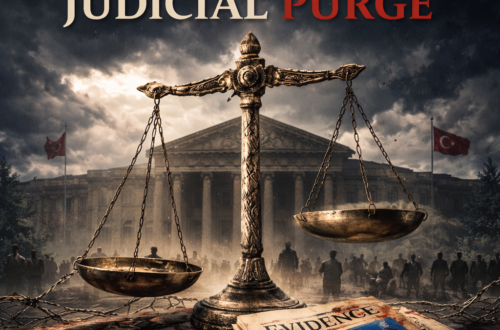
In the post–July 15, 2016 period in Turkey, lawyers have been forced to pay a heavy price for defending their clients, speaking out on human rights, pursuing allegations of torture, and objecting to trustee policies. In this article, we aim to document and illustrate these unlawful practices.
Pressures and Arrests of Lawyers in “FETÖ” Trials Since 2016
Following the July 15, 2016 coup attempt, lawyers defending clients accused of involvement with the group labeled “FETÖ” by the government encountered intense pressure and judicial harassment.
The term “FETÖ” and its designation as a “terrorist organization” were introduced and adopted by the government at the time. The Hizmet Movement, known as a religious-social community, was increasingly portrayed as a security threat after the 2013 corruption investigations (17–25 December), and after the coup attempt it was reclassified as a “FETÖ/PDY terrorist organization,” leading to tens of thousands of prosecutions.
This designation was shaped entirely by the political and legal narrative of the government. Many individuals and organizations have described it as “fabricated” or a “political tool.” The process of portraying the Hizmet Movement as a terrorist organization was embedded into public perception through intensive government-led campaigns, and the acronym “FETÖ” spread from official documents to media language.
Within this context, lawyers defending clients in “FETÖ” trials found themselves criminalized simply for exercising the right to defense.
One of the most severe legal violations of that period was the acceptance of both legal and non-legal acts as evidence of “membership in a terrorist organization” or “aiding a terrorist organization.”
For example, lawyers representing clients accused of involvement with “FETÖ” were themselves charged with “aiding a terrorist organization” or “membership in FETÖ.”
A striking example is lawyer G.T., who represented journalist Ekrem Dumanlı, and was imprisoned for nearly two years solely for serving as his attorney.
According to Anadolu Agency, the accusations against lawyer G.T. (Dumanlı’s relative) included canceling his subscription to the Digitürk platform after the STV channels were removed, having a bank account at Bank Asya, and his spouse having routine account activity of 20–35,000 TL during the period labeled as a “rescue operation.”
These basic financial activities—entirely ordinary—were treated as evidence of terrorism.
The only real “reason” for his imprisonment was that he acted as Dumanlı’s lawyer.
Such interpretations demonstrate the collapse of rational legal assessment in the judiciary and severely undermine the rule of law.
Another example is my cellmate, Attorney Erol Bey.
There was no personal relationship between him and Dumanlı.
However, their wives knew each other because they lived in the same neighborhood and had phone conversations—using phones registered in their husbands’ names.
This ordinary social contact between two neighbors was treated as “evidence of FETÖ membership.”
Erol Bey was arrested on 5 April 2017 and held for 14 months.
There was no criminal act—only neighborly communication.
That such “evidence” appears in court decisions shows how severely legal reasoning had decayed.
Throughout this period, the lawyer–client relationship—an essential element of the right to defense—was frequently reinterpreted as “membership,” “propaganda,” or “assistance to a terrorist organization.”
Lawyers were subjected to investigations, detentions, arrests, and lengthy prison sentences simply for performing their profession.
These practices directly targeted the independence of the defense and violated international human rights standards (such as the UN Basic Principles on the Role of Lawyers—Havana Rules).
Another key practice was the restrictions imposed by the High Council of Judges and Prosecutors (HSYK/HSK).
In December 2017, 322 lawyers under investigation for “FETÖ” were prohibited from representing any client accused of the same offense.
In December 2018, a similar ban was imposed on 131 lawyers in cases linked to the MLKP.
These decisions effectively removed many lawyers from the profession and directly restricted the right to defense.
Reports Confirm Systematic Pressure
- According to Weltanwälte e.V. (2023), since 2016:
- 1,638 lawyers have been investigated
- 903 detained
- 665 arrested
Most were involved in “FETÖ-related” defense work.
- UN High Commissioner for Human Rights (2018) reported:
- 570 lawyers in prison
- 1,470 under investigation
- 79 sentenced to severe penalties
- The Jailed Lawyers Initiative (2021) recorded:
- Over 1,600 investigations
- 615 detentions
- 474 lawyers receiving a total of 2,966 years in prison.
- Human Rights Watch (2019) described the situation as
“a direct attack on lawyers and the right to a fair trial.”
HRW documented numerous cases where representing a “FETÖ” suspect was itself treated as evidence of terrorism.
CHD Lawyers and Widening Criminalization
Many members of the Progressive Lawyers Association (ÇHD), though not directly linked to “FETÖ,” were prosecuted for “membership in a terrorist organization,” especially in politically sensitive and human-rights-focused cases—sometimes involving intersecting clients. Several received sentences of up to 12 years, often based on questionable evidence, contradictory testimony, or unlawfully obtained statements.
In 2023, parts of the case were overturned by the Court of Cassation—but the detentions continued.
Large-Scale Operations Targeting Lawyers (2017)
Multiple waves of arrest operations in Istanbul targeted lawyers alleged to be part of a “lawyer structure” within “FETÖ”:
- February 2017 → 95 lawyers targeted, 22 arrested, 34 warrants issued
- April 2017 → 38 detained, 30 arrested
- June 2017 → 189 detention warrants issued
These operations severely undermined the independence of the defense and were widely criticized by international human rights organizations.
Conclusion
The post–July 15 era has been one of the gravest tests for the legal profession in Türkiye.
In trials—especially “FETÖ” cases—lawyers representing clients were criminalized simply for performing their duties. Routine financial activity was treated as evidence of terrorism; attorney–client communication was labeled “assistance to an organization”; lawyers were imprisoned for years merely for representing journalists or dissidents.
These practices did not only target individual lawyers—they threatened the entire society.
If the lawyer is endangered, the defense is endangered.
If the defense is endangered, freedom and the rule of law are endangered.
The Significance of January 24
Declared in memory of the five lawyers murdered in the 1977 Atocha massacre in Madrid, the Day of Endangered Lawyers is a global symbol of resistance, hope, and the fight for justice.
In Türkiye, the day was highlighted in 2012, 2019, and again forcefully in 2025 through a joint declaration of the Union of Turkish Bar Associations and all 81 provincial bar associations.
The message was clear:
“If lawyers are in danger, the right to defense is in danger.”
Yet, even the Ministry of Justice’s 2025–2029 Judicial Reform Strategy failed to include violence against lawyers—showing how deeply the crisis has become institutionalized.
January 24 is not only a day of remembrance;
it is a living symbol of resistance, hope, and the struggle for justice.
As long as lawyers stand for the power of law against the power of the powerful,
the conscience of society will not dim,
and the guarantee of freedom will remain standing.
If we lawyers are in danger, then the defense—that is, the people themselves—are in danger.
But as long as we resist, the people will resist.
For the defense is the people;
and as long as the lawyers who represent the defense persevere, goodness and justice will ultimately prevail.
On this meaningful day, we honor all lawyers who are pressured, arrested, threatened, or continue to practice fearlessly.
We once again declare our determination to safeguard the independence of the defense, restore the right to a fair trial, and uphold the rule of law.
January 24 does not merely remind us of past pain;
it carries the hope of the future.
Nurturing that hope is our shared responsibility.
Mahmut Haldungil