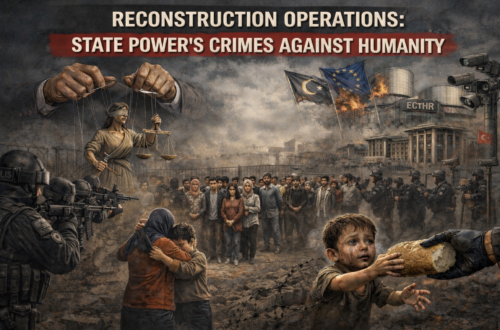

Arbitrariness, Inequality, and the Practice of Creating “Crimes Without Law” in the Assessment of Evidence
The Erosion of the Rule of Law
The principle of the rule of law, defined in Article 2 of the Turkish Constitution, requires that all state actions be limited by law and that individuals live under conditions of equality, justice, and freedom. Justice is the foundational pillar of any society: during periods when it is strong, economic development and social peace flourish; when weakened, societies face decline.
The systematic erosion of the sense of justice leads to consequences far beyond individual grievances: social trust collapses, investment declines, brain drain accelerates, and the cultural fabric is damaged. Therefore, judicial errors should remain exceptional, and mechanisms for correcting errors must operate effectively.
However, this fundamental principle was severely damaged by political interventions following the corruption investigations of 17–25 December 2013. The coup attempt of 15 July 2016 was then used as a justification to render these interventions permanent. Hundreds of thousands of people were dismissed through emergency decrees (KHKs) without judicial review; vague, non-legal concepts such as “connection” (irtibat) and “affiliation” (iltisak) were used to justify accusations of terrorism.
One early and symbolic sign of this legal breakdown was the treatment of law enforcement officers involved in the 17–25 December investigations. While some officers remained imprisoned for years, materials documented in official records during the investigations—such as audio recordings (“tapes”) and large sums of cash found in shoe boxes—were publicly disputed through contradictory narratives. For example, despite claims that the cash had been planted by police as part of a “plot,” these funds were later returned to the corruption suspects through official protocols.
On the one hand, the state advanced a “plot” narrative; on the other, it acknowledged the legitimacy of the investigation procedures by returning the seized cash. Meanwhile, the officers who conducted the investigation were prosecuted. This contradictory approach raised serious concerns regarding the reliability of evidence, the legitimacy of investigations, and consistency in state action—all essential elements of the rule of law.
I. The Dismantling of Judicial Independence and the Creation of a Climate of Fear
Following the 15 July coup attempt, the State of Emergency (2016–2018) triggered the most significant institutional collapse in the history of the Turkish judiciary. More than 4,500 judges and prosecutors were dismissed and thousands were arrested—removing nearly one-third of the judiciary from the system. Rapidly appointed replacements rendered the Council of Judges and Prosecutors (HSK) effectively subordinate to the executive.
The Criminal Judgeships of Peace became focal points of political pressure in detention and appeal procedures. Judges who issued release decisions were suspended, reassigned, or subjected to investigations, creating a powerful climate of fear. In this environment, judicial conscience was replaced by concerns for personal safety, career prospects, and political loyalty.
The hierarchical structure of the judiciary also collapsed. The fact that the Court of Cassation (Yargıtay) refused to comply with Constitutional Court rulings—most clearly during the Can Atalay crisis—demonstrates the collapse of the legal hierarchy. Similarly, systematic non-compliance with ECtHR judgments shows that this collapse has extended into the sphere of international law.
Authorities have refused to implement ECtHR judgments regarding Osman Kavala and Selahattin Demirtaş, despite their binding nature under Article 46 of the ECHR. Instead of remedying violations, new prosecutions and detentions were initiated to neutralize the impact of ECtHR decisions.
II. The Anti-Terror Law (TMK): Discriminatory Application and Double Standards
The Anti-Terror Law is applied in Hizmet Movement cases in a manner that openly violates the principle of equality (Article 10 of the Constitution; Article 14 of the ECHR). Identical actions yield radically different outcomes depending on the targeted group.
1. Reversal of the Presumption of Innocence
Despite constitutional and ECtHR guarantees, courts have treated individuals as guilty unless they prove their innocence.
In many cases, the inability to provide evidence of non-connection with the organization has been interpreted as proof of guilt. Thus, the burden of proof has been wrongfully shifted to the accused, nullifying the principle in dubio pro reo (“when in doubt, the defendant must be acquitted”).
The ECtHR clearly condemned this approach in Yalçınkaya v. Türkiye, ruling that legal and peaceful activities cannot justify automatic assumptions of guilt.
2. Pretrial Detention as the Norm
Although detention is supposed to be an exceptional measure, it has become the rule in these cases. Detention periods have been extended with generic and abstract reasoning, turning pretrial detention into a form of punishment.
The ECtHR has repeatedly ruled that such automatic detentions violate Articles 5 and 6 of the Convention.
3. Automatic Crime-Generation Mechanisms (e.g., “FETÖMETRE”)
Tools like FETÖMETRE, which produce probabilistic risk scores based on hundreds of bureaucratic criteria, have replaced judicial reasoning.
The ECtHR has held that such “total evidence approaches” cannot establish membership in a terrorist organization unless connected to violence.
III. Creating Crimes Without Law: Arbitrary Assessment of Evidence
Although terrorism under ECtHR jurisprudence requires violence, weapons, or concrete acts, in Turkey the following lawful acts have been treated as terrorist offenses:
- Opening an account at Bank Asya → Financing terrorism
- Joining a trade union → Organizational activity
- Using ByLock or similar apps → Conclusive evidence of guilt
- Attending religious gatherings or sending children to legal schools → Proof of membership
Despite ECtHR rulings rejecting such approaches, Turkish prisons remain overcrowded—approximately 40% over capacity—with political prisoners forming a significant proportion.
IV. The Construction of the “FETÖ” Label and the Mechanism of Social Criminalization
A. “FETÖ” as a Vague and Expandable Label
The state constructed the term “FETÖ” not as a legally defined crime but as a flexible and retroactively applicable political label. This label enables the presumption of guilt without individualized evidence, violating the principle of legality.
B. HTS Records as Automatic Evidence
Most prosecutions rely on unverified and unsigned telecommunications (HTS) records, often consisting of simple printouts. Courts frequently refuse to scrutinize their authenticity, making it impossible for defendants to challenge them.
C. Media-Led Stigmatization
State-controlled media systematically portrays individuals as “terrorists” before trial, violating ECtHR precedents such as Allenet de Ribemont v. France (1995).
D. Collective Criminalization
The label “FETÖ” transforms criminal law from a system based on individual guilt into one based on identity, affiliation, or historical associations—explicitly violating the principle that “criminal responsibility is personal.”
V. Resistance to International Law and Loss of Legitimacy
The ECtHR’s Yalçınkaya judgment required general measures, including the reopening of thousands of cases.
However, domestic courts have openly resisted implementation. Reopening requests under Article 311 of the Criminal Procedure Code have been largely rejected. In 2025, this resistance became even more visible in collective decisions such as Demirhan and Others.
The Council of Europe’s Committee of Ministers has repeatedly criticized Turkey for failing to implement the judgment and signaled that it may resort to enhanced monitoring or sanctions under Articles 46/3–5 of the Convention.
European asylum authorities—especially in Germany, the Netherlands, Belgium, France, and the UK—have examined Turkish judgments and concluded that they lack credible evidence of violence. As a result, asylum acceptance rates for Hizmet Movement members remain extremely high (70–90%).
Human Rights Watch and Amnesty International reports for 2025 confirm this legitimacy crisis.
VI. Erosion of the Rule of Law and Economic Decline: Inflation and Rising Costs
The link between the rule of law and economic performance is well documented globally.
Turkey illustrates this connection clearly:
- In the 2025 Rule of Law Index, Turkey ranked 118th out of 143 countries.
- Foreign direct investment has fallen from $22 billion (2007) to $11 billion (2024).
- The Turkish lira’s instability has fueled inflation, which reached 31% (TÜİK) or 57% (ENAG) by late 2025.
Weak judicial protection of property rights accelerates capital flight and deepens economic fragility.
VII. Absence of Legal Resistance: Social Apathy, Economic Dependence, and the “State = Government” Fallacy
Judicial collapse has persisted not only due to political design but also because of:
- Weak societal demand for the rule of law
- Absence of democratic oversight
- Economic dependence on the ruling elite
- Vulnerability caused by poverty and inflation
- Widespread internalization of the idea that “criticizing the government means attacking the state”
This environment produces a kleptocratic governance model, where law becomes a tool for maintaining political loyalty and distributing rents.
Conclusion
As demonstrated, the judiciary in Turkey has largely abandoned its constitutional duty to uphold the rule of law and has become an instrument of political power.
This breakdown has produced widespread injustice and long-term societal trauma, while accelerating brain drain and weakening Turkey’s economic and institutional capacity.
Domestic checks and balances have become ineffective, leaving implementation of the rule of law increasingly dependent on international mechanisms such as the ECtHR and the Council of Europe.
However, lasting reform requires not only external pressure but also strong societal demand for justice, accountability, and democratic governance.
History will distinguish those who stood on the side of law and justice from those who stood with power and illegality.
Mahmut Haldungil