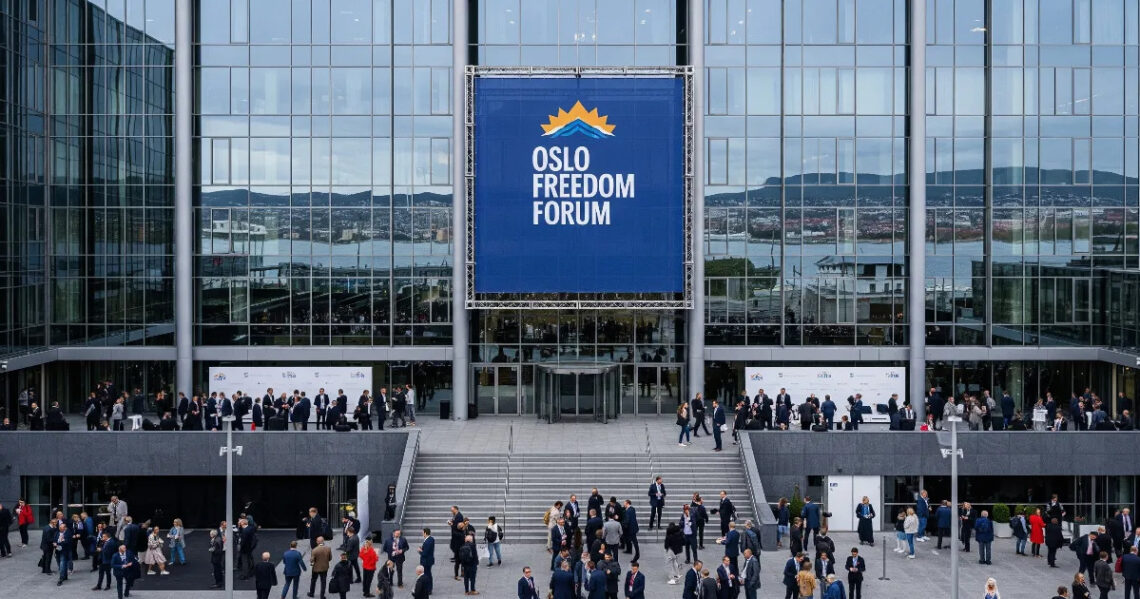
This report, prepared from the perspective of a legal expert specializing in International and European human rights law, presents a legal, analytical, and evaluative observation of the 18th annual Oslo Freedom Forum (OFF). Held at the Oslo Konserthus from June 1 to 3, 2026, under the banner “Dismantling Dictatorship,” the forum revealed a complex intersection of grassroots heroism, strategic geopolitical alignment, evolving technologies, and innovative methodologies in human rights advocacy. The following concluding remarks provide a systematic analysis of the forum, drawing directly from the testimonies of key speakers and network participants.
- Protecting the Lawyers Who Defend Democracy
An assessment of the proceedings of the Oslo Freedom Forum 2026, when viewed through the lens of European and international human rights law, reveals a deep disconnect between human rights advocacy networks and formal international legal institutions. Civil society organizations, such as the Amsterdam Law Centre, highlight this functional divide. Traditional legal advocacy focuses on rules, procedural frameworks, and evidentiary standards within formal judicial systems like the European Court of Human Rights (ECtHR). In contrast, public forums prioritize personal narratives to shape public policy and build awareness of human rights advocacy in general.
From a legal perspective, human rights lawyers operating in authoritarian settings face unique challenges. They encounter severe risks—such as criminalization, surveillance, asset freezes, and physical danger—often under the guise of state security laws. To counter this transnational repression, legal defense organizations must move beyond purely regional responses. Instead, they need to build structural alliances with established European legal networks. Key groups in this space include:
● The European Association of Lawyers for Democracy and World Human Rights (ELDH);
● The European Democratic Lawyers (AED-EDL);
● The International Observatory for Lawyers in Danger (OIAD).
Therefore, working with these transnational networks allows advocates to use international mechanisms, such as the United Nations Special Rapporteurs, to pressure authoritarian states. These collaborative efforts help protect lawyers on the ground and strengthen strategic litigation efforts. Integrating this work with international legal gatherings is crucial. Key events for coordination include the International Bar Association (IBA) Annual Conference in Copenhagen and the Day of the Endangered Lawyer. These forums provide a vital opportunity to transform public awareness raised at summits like the Oslo Freedom Forum into formal accountability measures before international bodies. - AI, Privacy, and the Use of Bitcoin Against Dictatorships
The discussions at the Oslo Freedom Forum 2026 underscored how technology has become a central battleground in human rights advocacy, serving simultaneously as a tool for resistance and a mechanism for state control. Authoritarian governments increasingly use digital surveillance, biometric tracking, and algorithms to limit civic space. In response, human rights groups are developing decentralized tech solutions. Workshops led by the Human Rights Foundation’s AI lead, Justin Moon, highlighted the deployment of custom AI tools designed to track human rights violations in real-time and bypass state censorship.
At the same time, financial censorship remains a key tool for authoritarian control. Regimes routinely freeze bank accounts and seize the assets of dissidents and legal professionals to halt their work. In this context, decentralized financial networks like Bitcoin serve as an alternative financial route. Because Bitcoin operates outside traditional banking controls, it allows international human rights groups to send resources directly to activists in closed societies, effectively bypassing state oversight.
However, these digital tools present significant legal and practical challenges:
● State-Sponsored Spyware: Dissidents face constant threats from advanced spyware. This risk requires hands-on security measures, such as the hardware “spy checks” provided to participants at the forum to protect against data interception.
● Platform Neutrality and Free Speech: The presence of Telegram founder Pavel Durov brought attention to the complex legal responsibilities of tech executives. Durov addressed allegations concerning French domestic intelligence and the Romanian presidential elections. He stated that European authorities had pressured him to censor conservative political content on Telegram. This conflict highlights a growing legal challenge: balancing the right to free expression under Article 10 of the European Convention on Human Rights (ECHR) against state regulations aimed at curbing disinformation and cybercrimes.
In sum, for human rights lawyers, these trends illustrate that digital security and decentralized financial tools are no longer optional. They are vital for protecting clients, preserving evidence, and maintaining advocacy work in hostile environments. - Reporting by Journalists Against Authoritarians
Independent journalism remains an essential counterweight to authoritarian regimes, which frequently deploy state media to manipulate public perception and target marginalized groups. At the Oslo Freedom Forum 2026, exiled bloggers, investigative reporters, and media professionals who have faced state oppression shared strategic methodologies to bypass state censorship and document human rights abuses. These efforts are critical for exposing corruption and laying the groundwork for international advocacy.
From an international legal perspective, attacks on journalists directly violate the rights to freedom of expression and information, protected under Article 19 of the Universal Declaration of Human Rights (UDHR) and Article 10 of the ECHR. Authoritarian regimes utilize a variety of tactics to suppress independent media, including:
● Weaponized Legal Systems: Governments routinely exploit anti-terror laws, national security measures, and criminal defamation suits to silence critical voices and force the closure of independent outlets.
● Transnational Repression: Journalists living in exile face ongoing threats, including digital surveillance, cross-border physical attacks, and harassment directed at their families in their home countries.
● Algorithmic Censorship: Regimes implement deep packet inspection and automated filters to block independent news sites, severely restricting citizens’ access to objective information.
Consequently, to counter these pressures, independent media groups are increasingly adopting decentralized distribution methods, encrypted communication networks, and international collaborative partnerships. For human rights lawyers, verified journalistic reporting serves as a vital source of open-source evidence. This documentation is increasingly utilized to build rigorous cases for international courts, human rights treaty bodies, and global sanctions frameworks. - The Middle East in Turmoil: Geopolitical Wars and the Future of Democratic Governance
The remarks made by Gissou Nia during the discussions on Middle Eastern turmoil introduce a critical conceptual nuance to the structural analysis of autocracy:
“An authoritarian regime can exist even if the government of the State is secular.”
Within the context of international human rights law and the strategic observations gathered from the Oslo Freedom Forum 2026, this assertion strikes at the core of how authoritarian governance must be identified, critiqued, and dismantled.
The discussions at the forum took place against a backdrop of escalating regional conflicts, particularly across the Middle East, which present profound challenges to international human rights law. The breakdown of institutional safeguards during armed conflict allows both state and non-state actors to commit widespread violations with impunity, further complicating any prospective transition toward stable, democratic governance.
A. Deconstructing the “Secular Autocracy” Paradox
Gissou Nia’s statement highlights a frequent point of confusion in international relations and policymaking: the conflation of secularism with democratic governance. From an international human rights law perspective, a state’s ideological or theological alignment—whether theocratic, sectarian, or strictly secular—is completely distinct from its compliance with the rule of law and fundamental human rights.
Historically and contemporaneously, the Middle East has seen numerous secular regimes utilize the apparatus of state security to systematically violate civil liberties, suppress independent judiciaries, and engage in transnational repression. These regimes often adopt a pro-Western, secular facade or frame themselves as necessary shields against religious extremism to secure international legitimacy and funding. However, their underlying legal and security frameworks rely on arbitrary detentions, the criminalization of political dissent, and severe restrictions on freedom of expression (Article 10 ECHR; Article 19 UDHR). Therefore, secularism frequently serves as a regulatory mask that conceals deep institutional decay and autocratic control.
B. Geopolitical Selectivity and the Challenge to Universality
This paradox directly reinforces critiques regarding the selective focus of international advocacy highlighted by observers at the forum. While the main stage focused extensively on violations by self-evident, adversarial authoritarian regimes in Russia, Belarus, China, and Iran, structural human rights abuses perpetrated by nominal strategic partners—including secular autocracies in the Middle East—received significantly less attention.
For international legal experts, this selective focus highlights a systemic challenge. If international advocacy networks and funding bodies, such as those financing the forum, align their visibility strictly with the foreign policy priorities of Western donor nations, they risk compromising the core principle of universality enshrined in the UDHR and the ECHR. This principle demands that all state actions be held to the same objective legal standards, regardless of whether a regime claims legitimacy through religious dogma or secular nationalism.
C. Analytical Conclusions for Human Rights Advocacy
By integrating Nia’s observation into broader legal reasoning, it becomes clear that human rights advocates must look past a regime’s ideological branding. Civil society organizations, such as the Amsterdam Law Centre and Human Rights Solidarity, must focus their analytical energy on tracking actual institutional behavior rather than rhetorical alignment.
Whether a government is secular or religious, the legal criteria for authoritarianism remain identical: the systematic denial of due process, the suppression of political pluralism, the weaponization of the judiciary, and the targeted harassment of legal professionals and journalists. To safeguard the integrity of international law, advocacy organizations must apply these objective legal metrics universally, ensuring that accountability is pursued equally across all political structures in the Middle East and beyond. - Concluding Remarks and Recommendations
The 2026 Oslo Freedom Forum underscored that contemporary counter-authoritarian struggle requires a hybrid approach merging strict legal reporting with sophisticated public relations and digital defence. For civil society organizations seeking to maximize their impact within this ecosystem, a clear roadmap emerges:
● Duality of Action: Legal institutions must not abandon the meticulous, quiet work of drafting high-quality, evidence-based legal reports. However, these reports must serve as the empirical foundation for strategic, public-facing advocacy campaigns.
● Legal Networking: To transition personal visibility into systemic legal accountability, exiled human rights lawyers must actively bridge the gap between OFF networks and established European legal consortia. Sustained engagement should be targeted toward upcoming international key dates, including:
○ The OSCE Warsaw Human Dimension Conference (September 2026);
○ The International Bar Association (IBA) Annual Conference (Copenhagen, October 4–9, 2026);
○ The Day of the Endangered Lawyer (January 24, 2027);
○ World Law Congress (May 3–5, 2027).
● Coalition Building: Interorganizational alignment as demonstrated by the coordination between Turkish human rights advocates, European legal networks and international
foundations is essential to elevate underrepresented crises into mainstream human rights discourse.